

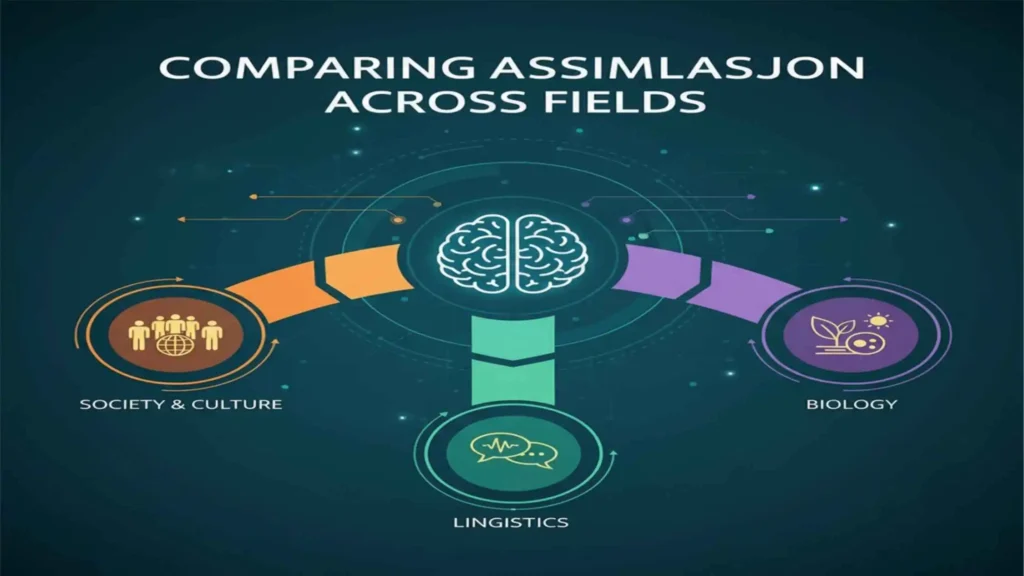
We live in a world where borders feel smaller every year. Families move countries for work, safety, or love. When they arrive, something quiet and powerful begins: they start changing. Gradually, virtually unaware of it, they acquire new vocabulary, new cuisines, new customs of celebrating birthdays and burying the dead. This great, profound movement is called in Norwegian assimilasjon.
Assimilasjon is more than learning a language or eating brunost for breakfast. It is the process where a person or an entire group lets go of enough of their original culture to blend almost completely into the new one. Sometimes it feels like freedom.
This article will take you in a stroll to what assimilasjon is actually, its origin, why it occurs in our hearts and minds, what it provides and what it deprives us of, and whether we even need to make a choice over it.
What Exactly Is Assimilasjon?
In its most basic sense, assimilasjon occurs when a member of Culture A begins to reside within Culture B to such an extent, in terms of time and intensity that they are now more likely to appear, sound, and even think more like Culture B than Culture A.
Experts usually talk about two big layers:
- Cultural assimilasjon – you switch holidays, music, clothes, jokes, food
- Structural assimilasjon – you attend the same schools, hold the same jobs, in the same clubs, and frequently even marry representatives of the majority group.
When both layers are complete, most people can no longer tell you ever belonged anywhere else.
A Painful and Proud History
Assimilasjon is not a modern invention.
| Time | Place | What Happened |
|---|---|---|
| Roman Empire | Everywhere they conquered | “Speak Latin, dress Roman, worship Roman gods—or stay on the outside” |
| 1800s–1950s Norway | Sami and Kven people | Government banned Sami and Finnish languages in schools; children were beaten for speaking their mother tongue |
| Early 1900s USA | Italian, Irish, Jewish immigrants | “Americanization” programs taught immigrants to drop accents and old holidays |
| France today | North African immigrants | Strong pressure to speak only French in public, no religious symbols in school |
In Norway the word assimilasjon still carries scars because of what was done to the Sami. Entire generations grew up ashamed of their own grandparents. Today Norway spends millions trying to bring back languages and traditions that assimilasjon once nearly killed.
Why Do Our Brains Even Allow This?
Psychologist John Berry studied thousands of immigrants and refugees. He discovered we usually pick one of four paths when two cultures meet:
| Path | Keep your old culture? | Adopt the new culture? | How you feel in the end |
|---|---|---|---|
| Integration | Yes | Yes | Comfortable in both worlds – happiest outcome |
| Assimilation | No | Yes | Fully part of the new place – but something is missing |
| Separation | Yes | No | You stay inside your own group – safe but sometimes lonely |
| Marginalization | No | No | You belong nowhere – highest risk of depression |
Research keeps showing the same thing: pure assimilasjon is rarely the healthiest choice.
The Slow Steps of Assimilasjon
It almost never happens in one big jump. Instead, it creeps forward in stages:
- First contact – Everything is new and interesting (and exhausting).
- Culture shock – The food tastes wrong, the humor is strange, you miss smells from home.
- Trying to fit – You learn the most useful sentences, copy how people dress on the bus.
- Getting comfortable – You dream in the new language, laugh at local TV shows.
- *Full assimilasjon – Your own children roll their eyes when you try to cook “the old food.” They feel 100 % Norwegian (or American, or French) and nothing else.
The Good Things It Brings
| Advantage | Real-life effect |
|---|---|
| Language mastery | Better jobs, higher pay, easier friendships |
| Feeling you belong | Less daily racism or suspicion |
| Children do better at school | They grow up without the “immigrant kid” label |
| National cohesion | One shared set of rules and stories makes a country feel less divided |
The Hidden Costs
| Loss | What it really means |
|---|---|
| Mother tongue fades | Grandchildren can’t talk to grandparents |
| Identity holes | “I don’t feel fully Polish… but I’m not really Norwegian either” |
| Family arguments | Parents want halal or kosher food; teenagers just want pizza |
| Cultural treasures disappear | Recipes, wedding songs, children’s games no one teaches anymore |
Stories Happening Right Now
- When he is six years old, a Pakistani boy comes to Oslo. On the age of twenty-five he speaks Oslo dialect flawlessly, he is a fan of Vålerenga football club, and only eats kebab when he is drunken. Classic assimilasjon.
- In Stavanger, a nail salon run by a Vietnamese family is opened. The parents continue incense burning on ancestors. The daughter is a student of medicine, who is engaged with a boy at Tromsø and who has not spoken Vietnamese in many years.
- Third-generation Mexican-Americans in California: they speak only English, and they celebrate Thanksgiving more actively as compared to Cinco de Mayo.
How Many Generations Does It Take?
| Generation | Language at home | Holidays & traditions |
|---|---|---|
| 1st | Only mother tongue | 100 % from the old country |
| 2nd | Both languages | Christmas + Eid, tacos + lutefisk |
| 3rd | New language only | Hardly any old-country traditions |
In Norway today, children of Somali, Polish, or Iraqi parents often reach near-full assimilasjon by the time they finish university—especially if they grew up in small towns.
Do You Have to Assimilate?
No. Thousands of families prove every day that you can belong without disappearing.
They:
- Speak flawless Norwegian at work and Punjabi or Arabic at home
- Put up both a Christmas tree and Ramadan lights
- Teach their kids two histories, two sets of grandparents’ recipes
- Feel proud, not torn
That path has a different name: integration. And almost every study says it makes people happier and healthier.
Frequently Asked Questions
Q: Is assimilasjon good or bad? A: It’s neither 100 % good nor 100 % bad. It can give safety and success, but it can also leave invisible wounds.
Q: Was the old Norwegian policy toward the Sami actual assimilation? A: Yes, and it was forced. That is why the government today calls it a dark chapter and works on reconciliation.
Q: Can you ever reverse assimilation? A: Yes, but it’s hard. Many young Sami adults are now re-learning their language and wearing traditional clothing again.
Q: Why do some groups resist assimilation more than others? A: Strong religion, tight family networks, and sometimes painful experiences with the majority culture make people hold on tighter.
Q: Will everyone eventually assimilate in the end? A: Probably not. With internet, cheap flights, and streaming in every language, it’s easier than ever to stay connected to the old country.
Final Thoughts
Assimilasjon is one of the most powerful forces in human history. It has built nations and broken hearts in the same breath. It can turn a frightened refugee into a confident citizen—and it can silence a language forever.
Norway, like many countries, has learned the hard way that forcing people to assimilate leaves scars that last for generations. Today the official goal is no longer “become exactly like us.” It is “become part of us—while still being you.”
The most beautiful future is not a country where everyone ends up the same. It is a country where a girl can ski to school in the morning wearing the latest Helly Hansen jacket, then come home and help her mother roll perfect injera or lumpia with the same proud smile.
